
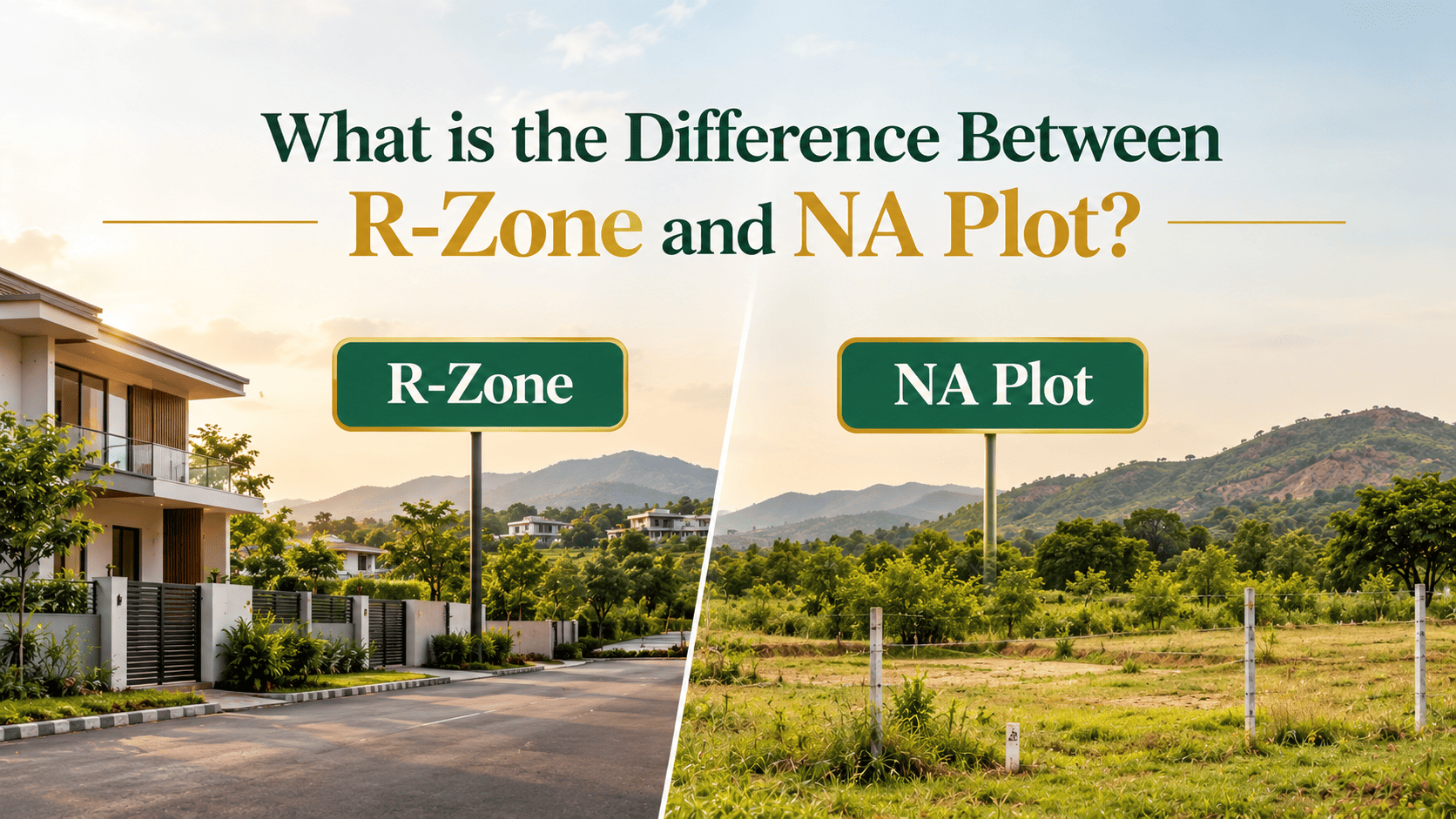
Buying a plot is a major investment, but understanding the land's legal status is just as important as checking its location and price. Two terms that often confuse buyers are R-Zone and NA plot.
So, what is difference between r zone and na plot? R-Zone refers to the zoning of land for residential development, while an NA plot refers to land that has been converted from agricultural to non-agricultural use. These are two different concepts, and one does not automatically mean the other.
What Is R-Zone Land?
R-Zone generally means Residential Zone. It refers to land that has been marked for residential development under a development plan or regional planning framework.
For example, if a piece of land falls within an R-Zone, it means residential use may be permitted under the applicable planning rules. However, this does not necessarily mean that the land has already been converted from agricultural to residential or non-agricultural use.
This is one of the most important points buyers should understand.
An R-Zone classification mainly tells you about the planned or permitted use of the area. It does not by itself confirm that all approvals required to construct a house have been obtained.
What Is an NA Plot?
NA stands for Non-Agricultural. Agricultural land is generally meant for farming and agricultural activities. When land is legally permitted or converted for a non-agricultural use, such as residential development, it is commonly referred to as NA land.
In Maharashtra, the Maharashtra Land Revenue Code, 1966 regulates the use of agricultural land for non-agricultural purposes. The applicable process and permissions can depend on the location and circumstances of the property.
An NA residential plot is therefore different from simply saying that land falls within an R-Zone.
Difference Between R-Zone and NA Plot
The easiest way to understand what is difference between R zone and NA plot is to compare their purpose and legal status.
|
Factor |
R-Zone Land |
NA Plot |
|
Meaning |
Residential Zone |
Non-Agricultural land |
|
What it indicates |
Planned/permitted residential use under zoning rules |
Land permitted/converted for non-agricultural use |
|
Agricultural status |
May still be agricultural |
Converted/permitted for non-agricultural use, as applicable |
|
Construction |
May require further permissions and conversion |
Residential construction may be possible subject to approvals |
|
NA conversion |
May still be required |
Already completed or otherwise legally permitted, depending on the case |
|
Layout approval |
Must be checked separately |
Must also be checked separately |
|
Infrastructure |
May or may not be developed |
Depends on the project and location |
|
Buyer risk |
Can be higher if approvals are incomplete |
Generally clearer when all documents and approvals are in place |
|
Best suited for |
Buyers considering future development |
Buyers looking for land for residential development |
Why Do Buyers Prefer NA Plots?
For buyers planning to construct a home, an NA plot can offer greater clarity when the necessary conversion, layout and development approvals are already in place.
Some potential advantages include:
- Clearer land-use status
- Better understanding of permitted use
- Easier planning for residential development
- Lower risk of discovering that agricultural-use restrictions remain
- Better documentation when the project has proper approvals
However, buyers should not assume that the word NA alone guarantees that a plot is completely ready for construction.
You should also verify the sanctioned layout, access road, development permissions, building regulations and other applicable approvals.
Which Is Better: R-Zone or NA Plot?
For someone who wants to build a house soon, an appropriately approved NA residential plot is generally the more straightforward option, provided its documents, layout and other approvals are properly verified.
R-Zone land can be considered by buyers who are comfortable with a longer development timeline and who have independently verified that the required approvals can be obtained.
The right choice depends on your objective.
|
Your Goal |
Better Option |
|
Build a house soon |
Properly approved NA residential plot |
|
Long-term land investment |
R-Zone or NA, after legal verification |
|
Lower initial purchase price |
R-Zone may sometimes be cheaper |
|
Greater clarity for residential development |
Properly approved NA plot |
|
Avoid dealing with future conversion |
NA plot with valid documentation |
How to Check a Plot Before Buying
Follow these steps before signing an agreement:
- Check the seller's ownership documents.
- Verify the 7/12 extract, 8A or property card, as applicable.
- Confirm the zoning of the land.
- Check the NA status and relevant permission/order.
- Verify the approved layout plan.
- Check road access and basic infrastructure.
- Look for mortgages, disputes or other encumbrances.
- Check RERA registration if applicable.
- Have a property lawyer verify the documents.
- Only then proceed with the purchase agreement and payment.
Conclusion
The main difference is that R-Zone describes where and how land is planned or permitted to be used under zoning regulations, while NA describes land that has been permitted or converted for non-agricultural use.
An R-Zone plot is therefore not automatically an NA plot. A buyer should verify the land's revenue records, NA status, zoning, layout approval and other applicable permissions before purchasing.
If you want a peaceful weekend home surrounded by nature, Trinity Phase I by Nature Wealth offers a well-planned gated community in Nashik, spread across about 8.5 acres with 28 plots and Tourist Home NA plot classification. The project combines open spaces, mountain surroundings, distant water views, and privacy with modern comforts such as a private clubhouse and restaurant, while select villas include private pools and decks.
With its spacious plots, secure community setting, scenic surroundings, and relaxed lifestyle, Trinity Phase I is a suitable choice for families who want to build a comfortable weekend home away from the busy city.
Frequently Asked Questions
1. Is R-Zone land safe to buy?
It can be, but buyers should first verify the land's ownership, zoning, NA status, layout approval and other applicable permissions.
2. Can I build a house on R-Zone land?
R-Zone classification alone does not guarantee immediate construction permission. Other land-use and development requirements may apply.
3. Is an NA plot better than an R-Zone plot?
For buyers planning residential construction, a properly approved NA residential plot may offer greater clarity. However, all documents and permissions should still be checked.
4. Why is R-Zone land cheaper than NA land?
It may be cheaper because the land may still require conversion, approvals or infrastructure development.
5. Does R-Zone mean residential land?
R-Zone generally means that the area is designated for residential use under the applicable zoning or development plan. It does not by itself prove that the land has been converted to non-agricultural use.
6. What should I check before buying an NA plot?
Check the title, land records, NA documentation, approved layout, zoning, access, encumbrances and other applicable development permissions.







.png)
.png)















.png)

.png)



_(1).png)