
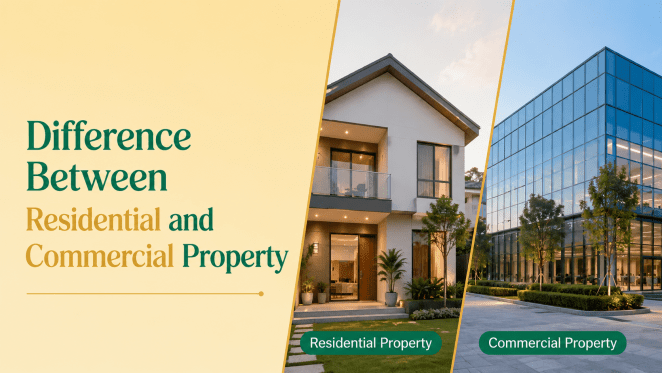
Residential property is any property used for living purposes, such as apartments, villas, and independent houses. Commercial property is any property used for business activities such as offices, shops, warehouses, and co-working spaces. While both are valuable real estate investments, they differ significantly in rental yield, taxation, risk, financing, and long-term returns.
The main difference between residential and commercial property is their purpose; one is for living, the other for business. Commercial properties offer higher rental yields (6-10%) but carry more risk. Residential properties offer a stable income (3-5% yield) with lower entry costs and easier financing.
What is the Difference Between Residential and Commercial Property?
Compare residential and commercial properties across investment cost, rental income, risk, maintenance, and long-term growth to choose the right real estate investment option.
|
Factor |
Residential Property |
Commercial Property |
|
Purpose |
Used for living, housing, and personal use. |
Used for business activities such as offices, shops, and commercial establishments. |
|
Rental Yield |
Generates rental returns of approximately 3-5% per year. |
Offers higher rental returns of approximately 6-10% per year. |
|
Initial Investment |
Typically requires an investment of ₹30 lakh – ₹2 crore+. |
Usually requires a higher investment of ₹50 lakh – ₹10 crore+. |
|
Interest Rate |
Home loans are available at approximately 8.5-9.5% interest. |
Loan interest rates are usually higher, at around 9.5-12% or more. |
|
Lease Duration |
Commonly rented on 11-month agreements or other short-term leases. |
Usually leased for 3-9 years, providing longer income stability. |
|
Tenant Turnover |
Tenant changes are relatively frequent. |
Tenant turnover is generally lower due to long-term lease agreements. |
|
Financing (Home Loan) |
Loans are easier to obtain and usually come with lower interest rates. |
Financing is more difficult and generally involves higher interest rates. |
|
Risk Level |
Considered a lower-risk investment option. |
Higher risk due to market and business-related factors. |
|
Tax Benefits |
Eligible for tax benefits under Section 24 and Section 80C. |
Investors may claim GST credits and depreciation benefits where applicable. |
|
Vacancy Risk |
Properties may remain vacant between tenants more often. |
Vacancy depends largely on location and business demand. |
|
Market Sensitivity |
Moderately affected by market conditions and economic changes. |
Highly influenced by economic growth, business activity, and market trends. |
|
10-Year Returns |
Typically offers average annual returns of around 8-9%. |
Can potentially generate higher annual returns of around 13 -15% over the long term. |
What is Residential Property?
Residential property refers to any real estate developed or used for human habitation. It is governed by local residential zoning laws and is typically financed through standard home loans.
Types of Residential Properties in India
- Apartments / Flats - Most common in urban areas like Pune, Mumbai, and Nashik
- Independent Houses / Bungalows - Found in suburban and tier-2 cities
- Villas and Row Houses - Premium gated community developments
- Studio Apartments - Compact units popular in IT hubs
- Plotted Developments - Land parcels in approved residential zones
What is Commercial Property?
Commercial property refers to real estate used exclusively for business purposes. It includes income-generating properties leased to businesses, corporates, or retail brands.
Types of Commercial Properties in India
- Office Spaces - IT parks, corporate offices, co-working spaces
- Retail Shops - High-street shops, showrooms, mall units
- Warehouses and Logistics Hubs - Industrial and distribution centres
- Mixed-Use Developments - Combined residential + commercial projects
- Hotels and Hospitality - Serviced apartments, boutique hotels
Rental Yield Comparison
Rental yield is the annual rent you earn as a percentage of the property's market value. This is one of the most important metrics for investors.
|
Property Type |
Typical Rental Yield |
Example |
|
Residential (Metro) |
2-4% |
₹2 crore flat in Pune earns ₹40,000-₹65,000/month |
|
Residential (Tier-2) |
3-5% |
₹60 lakh flat in Nashik earns ₹15,000-₹25,000/month |
|
Commercial (Office) |
6-9% |
₹5 crore office in Mumbai earns ₹2.5-₹3.75 lakh/month |
|
Commercial (Retail) |
8-10% |
Premium retail unit in Pune earns higher rent due to brand tenants |
Real Example: An investor who purchased a 3 BHK apartment in Hinjewadi, Pune, for ₹1.8 crore can expect a monthly rent of ₹30,000-₹45,000, translating to a 2-3% annual yield. In contrast, a commercial office unit of equivalent value in the same IT corridor could fetch ₹1-1.5 lakh per month, with a 6-10% yield.
Tax Benefits on Residential Property
For salaried individuals, investing in residential property offers direct tax savings on home loan interest under Section 24.
|
Tax Section |
Benefit |
|
Section 24(b) |
Deduction on home loan interest up to ₹2 lakh per year (self-occupied) |
|
Section 80C |
Deduction on principal repayment up to ₹1.5 lakh per year |
|
Section 80EEA |
Additional interest deduction of ₹1.5 lakh for affordable housing buyers |
|
TDS on Rent |
If the monthly rent exceeds ₹50,000, the tenant must deduct 10% TDS (Section 194IB) |
Tax Benefits on Commercial Property
For business owners, commercial property may offer more advantages via GST credits and depreciation.
|
Tax Section |
Benefit |
|
GST Input Tax Credit |
If you're a GST-registered business, you can claim ITC on commercial property purchases |
|
Accelerated Depreciation |
Commercial properties can be depreciated faster under business accounting |
|
Rental Income |
Taxed as "Income from House Property", you can deduct 30% standard deduction + loan interest |
|
TDS on Rent |
TDS of 10% is applicable if the annual rent exceeds ₹2.4 lakh (Section 194I) |
Legal & Regulatory Aspects of Residential and Commercial Property
Understand the key legal approvals, taxes, zoning rules, and compliance requirements that affect residential and commercial property investments.
Residential Properties
- Governed by RERA (Real Estate Regulatory Authority), which protects buyers
- Rental agreements are typically 11-month renewable licenses
- Eviction procedures for non-payment are governed by state Rent Control Acts
- Society maintenance charges regulated by the cooperative society rules
Commercial Properties:
- Not covered under RERA for lease agreements
- Commercial leases are long-term (3-9 years) with lock-in periods
- Governed by the Transfer of Property Act and commercial contract law
- GST @ 18% is applicable on commercial rent (if the landlord is GST registered)
- More complex due diligence required fire NOC, zoning approval, and an occupancy certificate
Indian Real Estate Market Trends 2026
Explore the latest Indian real estate market trends in 2026, including growing demand, investment opportunities, infrastructure development, and emerging property hotspots.
Residential Market in 2026
- Demand remains strong in Tier-1 and Tier-2 cities, Pune, Nashik, Nagpur, and Hyderabad
- Hybrid work models have pushed demand for 3BHK and larger apartments with home office space
- The affordable housing segment (₹40–70 lakh) is seeing increased buyer interest due to government incentives
- New metro corridors in Mumbai and Pune are driving residential capital appreciation in peripheral zones
Commercial Market in 2026
- Flex workspaces and co-working hubs continue to grow rapidly
- Warehousing and logistics properties are among the highest-performing commercial asset classes
- Grade-A office spaces in IT corridors (Hinjewadi, Magarpatta, Baner in Pune) are seeing strong occupancy.
Note: The data and figures used in this blog have been sourced from various websites and online resources available on the internet.
Which is Better for Investment: Residential or Commercial Property?
There are no universal answers; it depends on your profile as an investor.
Choose Residential Property If:
- You are a first-time investor or have limited capital
- You want easier financing with a smaller down payment
- You prefer lower risk and stable, predictable rental income
- You want to save tax on a home loan
- You are buying in Nashik, Pune, or Mumbai for personal + investment use
Choose Commercial Property If:
- You have higher capital (₹1 crore+) and can absorb more risk
- You want higher rental yields (6-10%) and long-term tenants
- You are a business owner who can use GST credits
- You are investing in a high-demand commercial zone like an IT park or retail hub
- You have a long-term investment horizon (10+ years)
Conclusion
As a buyer, understanding the difference between residential and commercial property can help you make the right investment decision. If you are looking for lower risk, easier financing, and steady returns of 3-5%, a residential property may be a better choice. However, if you have a larger budget and are comfortable with higher risk, a commercial property can offer higher rental yields of 6-10% and potentially greater long-term returns.
Looking for a peaceful escape close to nature? Nature Wealth offers thoughtfully planned villa plots, gated communities, second homes, and tourist homes in Nashik and Igatpuri. Ideal for weekend getaways and family holidays, these projects combine natural beauty, comfort, and modern amenities, helping you create memorable moments with your loved ones.
Frequently Asked Questions (FAQs)
1. Which gives better rental yield, residential or commercial property?
Commercial properties generally offer higher rental returns of 6-10%, compared to 3-5% for residential properties.
2. What are the tax benefits of residential property in India?
Homeowners can claim tax deductions under Section 24(b) and Section 80C on home loans.
3. Is GST applicable on residential property rent?
No, GST is not applicable on residential rent, but it may apply to commercial property rent under certain conditions.
4. Can NRIs invest in commercial property in India?
Yes, NRIs can invest in commercial properties, subject to applicable financing and regulatory requirements.
5. What is a good rental yield for commercial property in India?
A rental yield of 6-8% is considered good, while premium commercial properties can generate 8-10% or more.
6. Which property type is safer during an economic slowdown?
Residential properties are generally considered safer because housing demand remains more stable during economic downturns







.png)
.png)
















.png)

.png)



_(1).png)